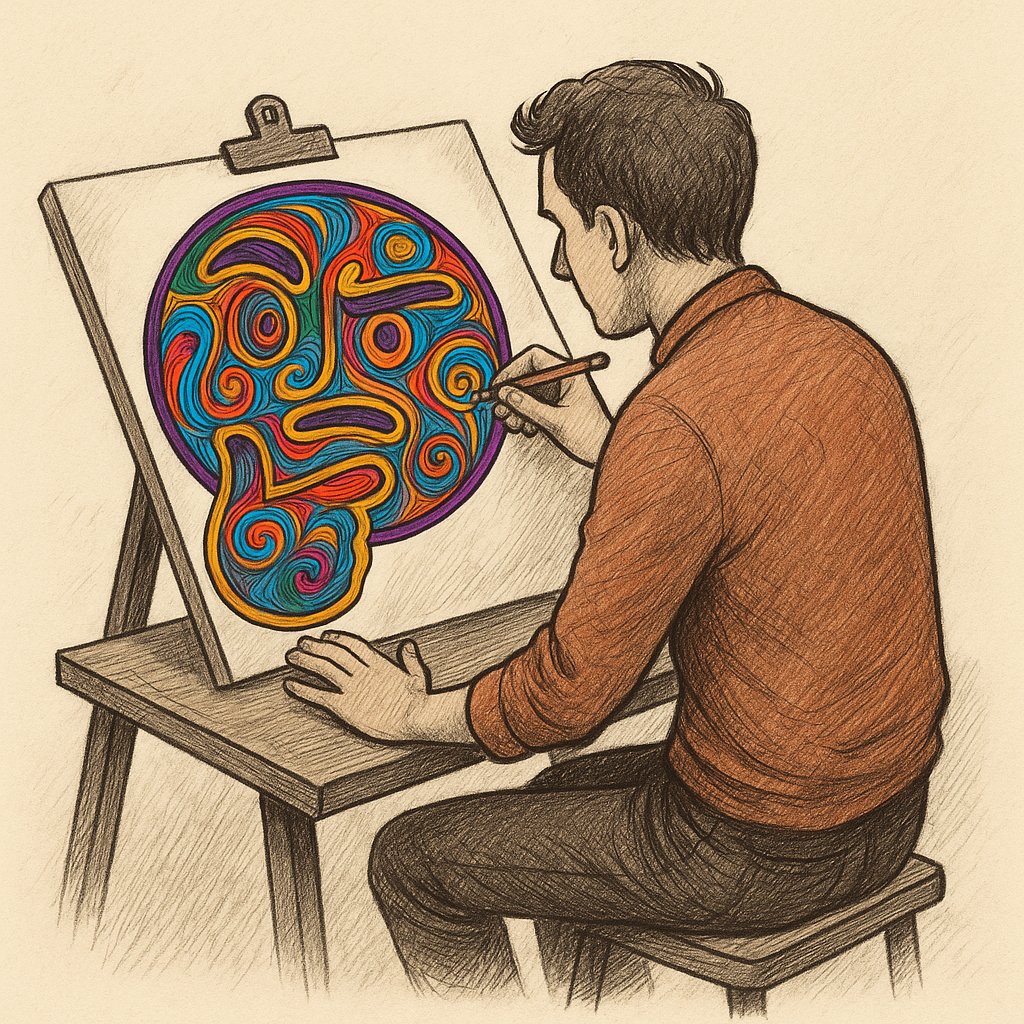
What if making something is just as valid when the only audience is you?
We don’t usually think of creativity that way. For centuries, making has been tethered to sharing—paintings for galleries, scripts for producers, songs for listeners. But much of human creativity has always been private: a doodle in a margin, a tune hummed absentmindedly, a secret journal.
AI tools are reigniting that quieter tradition. They accelerate and expand the joy of making for its own sake, turning what once lived at the edges into a creative playground anyone can step into. This doesn’t diminish creativity’s cultural value. But it reframes it as something more intimate: natural, necessary, and available to everyone.
Regression in the Service of the Ego
When I was a film student at NYU, I took a course in the ‘Psychology of Art’ with Professor Paul Vitz, a dead ringer for comedian Bob Newhart, with the same deadpan delivery. Vitz introduced me to a concept from psychoanalyst Ernst Kris that has stuck with me ever since: regression in the service of the ego.
Kris argued that creativity requires a temporary return to childlike, pre-rational modes of thought. Not destructive regression, but controlled retreat. In this state, the unconscious produces raw material through playful, seemingly nonsensical exploration. Then conscious, critical thought shapes that material into something communicable.
Two modes in dialogue: play first, structure later.
This is what most of us forget. As adults, we’re trained to skip straight to the structuring phase—productivity, validation, outcomes—while suppressing the messy, experimental play that makes true discovery possible.
What Children Teach Us
Every child knows they can draw. Most grown-ups say they can’t. Do we simply forget how? Or does our critical frame simply redefine the meaning of ‘draw’ as we age? When I worked at BBC Children’s, we built digital creative play tools for kids. The lessons were clear. Younger children didn’t care about validation. They would joyfully make things—drawings, little animations, silly mashups—just for the thrill of making.
But as children grew older, validation became more important. Competitions, leaderboards, and showcases were needed to keep them engaged. The act of making wasn’t enough anymore; external recognition mattered.
This progression mirrors Kris’s sequence. At first, there is unselfconscious play. Then comes critical thinking and contextualization—figuring out how to make something fit for an audience. By adulthood, many of us live almost entirely in the second stage. We’ve been trained to ignore play unless it can be justified by audience approval, career advancement, or market value.
AI unsettles this pattern. It invites us back into the first stage, where making can be playful, private, and unburdened by judgment.
Asimov’s Vision
Isaac Asimov foresaw this shift nearly fifty years ago. In a 1988 interview with journalist Bill Moyers, he predicted that as computers took over routine work, “there’s going to be nothing left for human beings to do but the more creative types of endeavor.” The problem, he warned, was that traditional schooling had “beaten the creativity out of” people by forcing everyone into the same standardized mold.
His alternative was radical: computers as personal tutors, a “one-to-one relationship between information source and information consumer.” Every home, he suggested, could have computer “outlets” where anyone might pursue whatever captured their curiosity—“however silly it might seem to someone else, it’s what you’re interested in.”
For Asimov, this wasn’t frivolous. Following your own bent was precisely how creativity flourished: from curiosity into discovery, from play into invention.
AI as Playground
The striking thing about AI is not that it’s “creative” in itself. It’s that it offers a non-judgmental partner for creative play. You can throw absurd prompts at it, chase tangents that would sound foolish in a workshop, generate endless variations without worrying about being wrong. The machine doesn’t roll its eyes. It doesn’t grade you. It simply responds.
That freedom matters. Professional education often disciplines us into avoiding risk, aligning with institutional expectations, and suppressing impulses that don’t fit. AI reverses that pressure. It makes it easier to play again, to indulge curiosity, to regress in the service of the ego.
In this sense, AI is not just a set of tools for professional storytellers or visual artists to make the blockbuster. It’s also the perfect personal creative playground: a space where making can be exploratory, self-directed, and free of consequence.
The Loop of One
With AI, the act of creation and the act of consumption can collapse into a single circuit. You make something, you delight in it, and that’s enough. The maker and the witness are the same person.
This doesn’t mean sharing disappears. You can still publish, exhibit, or broadcast what you make. But sharing is no longer the only measure of value. The act of creation is just as valid if the only audience is you—like cooking a meal for yourself, savoring its flavor even if no one else ever tastes it.
AI normalizes and accelerates this loop. It validates what children know instinctively: that making is worthwhile even when it isn’t seen, liked, or approved by others.
Breathing Creativity
Seen against the trajectory of the past two decades, this shift feels almost inevitable. Content has moved steadily from mass broadcast to narrowcast, from niche communities to one-to-one fandoms between artist and fan. The logic has always been toward intimacy, toward smaller or circles of recognition or more direct relationships between creators and consumers.
But maybe the real endgame isn’t 1-1. It’s one-to-self. The creation–consumption loop that begins and ends with you. Or is this the beginning of something new? After all, making things just for the joy of the act may be the most natural form of creativity—private, sustaining, and complete.
This doesn’t mean sharing disappears. Indeed, the professional artist’s capacity to form external context around the outputs of creative play will become ever more valuable for meaningful connection with others. But it does mean that sharing is no longer the only measure of value. Making and enjoying can be self-contained, like breathing: inhale, exhale. Make, enjoy. Make, enjoy.
If AI helps us remember that rhythm, then its greatest cultural impact won’t be in replacing professional artists or disrupting industries. It will be in restoring something much more fundamental: the capacity for every human being to take creative breaths.

 Polarity Reversal