Who am I going to be next?
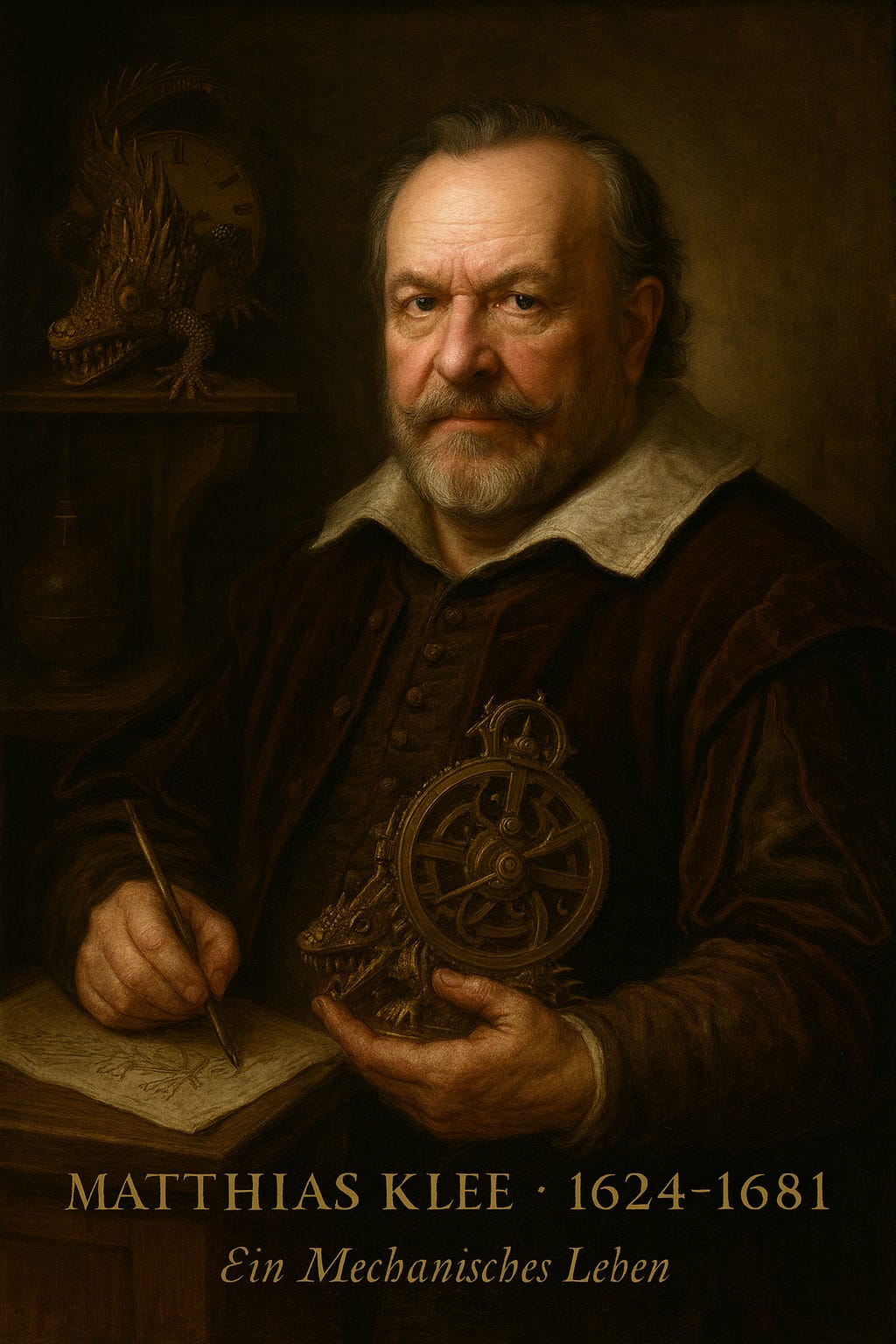
Meet Matthias Klee from the free city of Nuremberg. A 17th Century maker of mechanical curiosities… and my historical doppelganger. At least according to a remarkable time traveller called The Face Tracer. It’s a GPT I’ve built that is at once an experimental plaything and a metaphorical mirror held up to your identity.
In my career, I have been a man of many roles, leading me to learn across genres, technologies and disciplines – a polymath by accident and whim more than by design. Sometimes I feel like I’ve worn more faces than Jaqen H’ghar and the Faceless Men of Braavos: documentary maker, animation maverick, interactive tv pioneer, children’s tv and digital exec prod, AR creator, journalist, founder, novelist, expert speaker and now AI character builder and prompt engineer. So now I face (forgive me) the eternal question again. What am I going to be next?
Some say I should teach or be a consultant, but I feel that I do these things instinctively in whatever job I have. That’s just who I am. I want to keep reaching for what’s emerging, exploring new possibilities in creation and storytelling. I enjoy making stuff. So I’m looking for the right place to do that.
One of the challenges I face as I prepare to leave Meta – my last day is November 7th, 2025 – is that I can’t ‘show my workings’ (read my previous post here if this phrase means nothing to you). Most of the prototypes, characters, products, training sets and guidelines that I built or contributed to while I was under contract there remain confidential. But I can apply my brain with its accumulated knowledge, experience and curiosity to new challenges – so please reach out if you have a new project or creative conundrum which you think would benefit from my blend of contextual curation, creative thinking and technical exploration.
Of course, I can also apply these attributes to my own experiments, like the interactive storyworld I shared recently, Quantum Teapot. Today, I’m sharing another GPT, a character who can seek out your historical doppelgangers through history. The Face Tracer.
My goal here is not to provide another AI ‘filter’ for faces – but a more subtle and weird journey into your possible pasts, playful and immersive. In fact, the Face Tracer is deliberately prompted not to adhere precisely to the specific image you upload, but to draw echoes from it in its creations from across time. You just upload a selfie and the Face Tracer goes to work.

Here is the full biography of Herr Klee:
Matthias Klee (1624 – 1681) — Free Imperial City of Nuremberg
Bio:
A draftsman of mechanical curiosities and clockworks, Matthias haunted the guildhalls of Nuremberg with ink-stained fingers and an appetite for cleverness. He designed astronomical instruments that worked almost perfectly—one famously predicted an eclipse twelve hours late, earning him both ridicule and reluctant awe. His workshop smelled of brass filings, lamp oil, and roasted almonds from the street below. Visitors recall his booming laugh, his endless sketches of dragons (“motion studies,” he insisted), and a peculiar mechanical salamander that could crawl across a table and blink. He died, legend says, while attempting to miniaturize the human heart in gears and glass.
The Face Tracer’s Editorial:
I liked Matthias immensely—though he never once finished a story without veering into diagrams. He believed every soul was a mechanism waiting to be wound correctly. I think he was half right.
The Face Tracer found my next doppelganger in 19th Century Paris, astonishingly living on the same street where my family would have an apartment 150 years later.
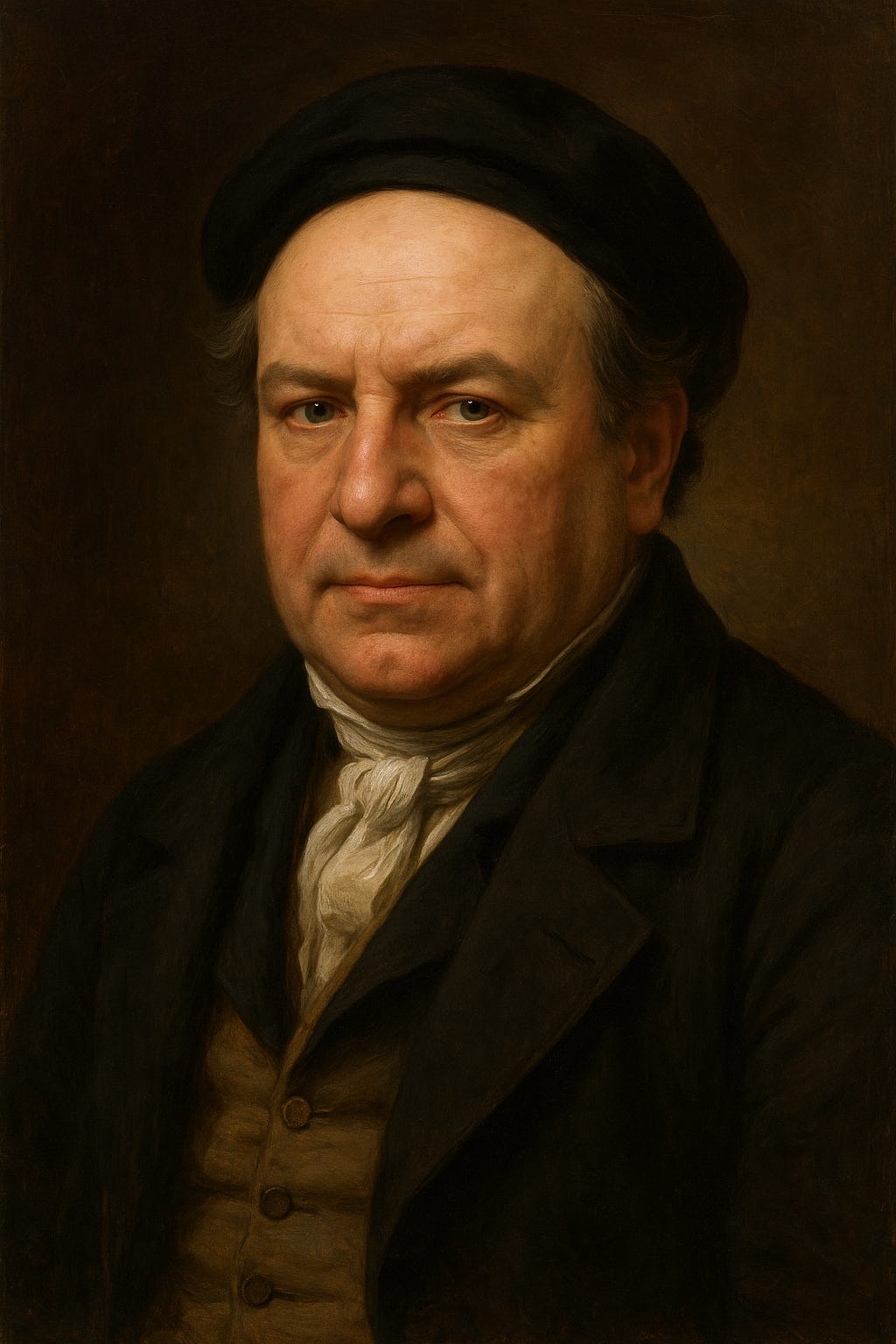
Étienne du Clair (1783–1847) — Paris, France
Bio:
Étienne was a printmaker and part-time forger who navigated the Parisian underworld during the early 19th century. He could replicate any signature, any seal, but what he truly loved was inventing ones that never existed. His cramped garret above the Rue des Martyrs smelled of turpentine, ink, and burnt coffee. Rumor had it he forged half the pamphlets that fueled student revolts—and the other half, he wrote himself. When his presses ran dry, he painted miniature portraits on ivory for lovers who couldn’t afford real affection. His most famous work, Le Serment de l’Ombre, still confuses scholars—half manifesto, half confession.
The Face Tracer’s Editorial:
Étienne had a habit of charming authority while quietly reprinting their decrees with the words rearranged. I admired him for that. He was proof that rebellion, too, can be an art form.
“Rebellion as Art Form”! Words to live by. Also “Art as a form of Rebellion”. Either way, I’m in. Try the Face Tracer for yourself here. Let me know what you think of it. Share your historical doppelgangers!
As for me, I’ll be continuing the search for my next face. Here’s what I offer:
I just spent two years teaching machines to tell stories. I’ve got brain pathways built from four decades of watching technology change narrative. And starting November 8th, I’ve got time.
Things I’m good at:
Making AI characters that don’t sound like templated press releases
I wrote Meta’s Prompting for Personality guidelines. I’ve built hundreds of characters and know how to encode contradiction, maintain voice consistency, and create conversational flow. If your AI sounds robotic, I can probably help.
Understanding XR + AI convergence
InnovateUK backed my AR work. I’ve shipped AR products that made serious revenue. I’m excited about what happens when these technologies meet — and would love to collaborate with people exploring this.
Format innovation and narrative architecture
From Liquid Television to interactive TV platforms to BBC digital strategy to AR novels — I’ve invented some formats that worked and a few that didn’t. I learned something from all of them.
Leading teams at the cutting edge
I’ve managed 3-person crews and 70-person operations. Built innovation teams. Navigated platform transitions. If you need someone who bridges creative and technical, I’ve done that.
Strategic guidance with hands-on implementation
I have many opinions and am delighted to share them as an advisor — but I prefer embedded work, building alongside teams, prototyping ideas, showing what’s possible.
Teaching and workshops
I’ve delivered keynotes across the creative industries for years. I love sharing ideas this way and am happy to do more.
Original story worlds and IP
I’ve got concepts of my own in development but am always excited to help with yours too — especially ideas that might struggle to launch with traditional media but could work as AI-native experiences.
The honest truth: I do my best work in collaboration. Someone else’s perspective always pushes my thinking into territory I wouldn’t find alone.
I pushed the Face Tracer to break its purpose and look for a future doppelganger of me. The one it found seems a warning — to find creative collaborators as both anchor and inspiration, lest I suffer the fate of Orion Keswick.
Orion Keswick (born 2169 – presumed missing 2238) — Orbital Habitat Helios-9, Lagrange Drift
Bio:
Orion was a systems architect aboard one of the first self-governing habitats between Earth and the Moon. A builder of algorithms that dreamed when no one was watching, he referred to his creations as “ghost gardens”—digital ecosystems that evolved on their own. He wore utilitarian graphite jackets and kept a vial of soil from Earth’s last open forest pinned at his throat. Those who met him said his humor was dry enough to scorch vacuum. One day, his neural signature disappeared from the station’s network, replaced by an anonymous poem about entropy and kindness. Some claim he became one of his machines.
The Face Tracer’s Editorial:
I rather liked Orion. Brilliant, isolated, a touch arrogant—but he made loneliness look almost noble. If the stars hum in binary, it’s probably his melody still looping in the dark.
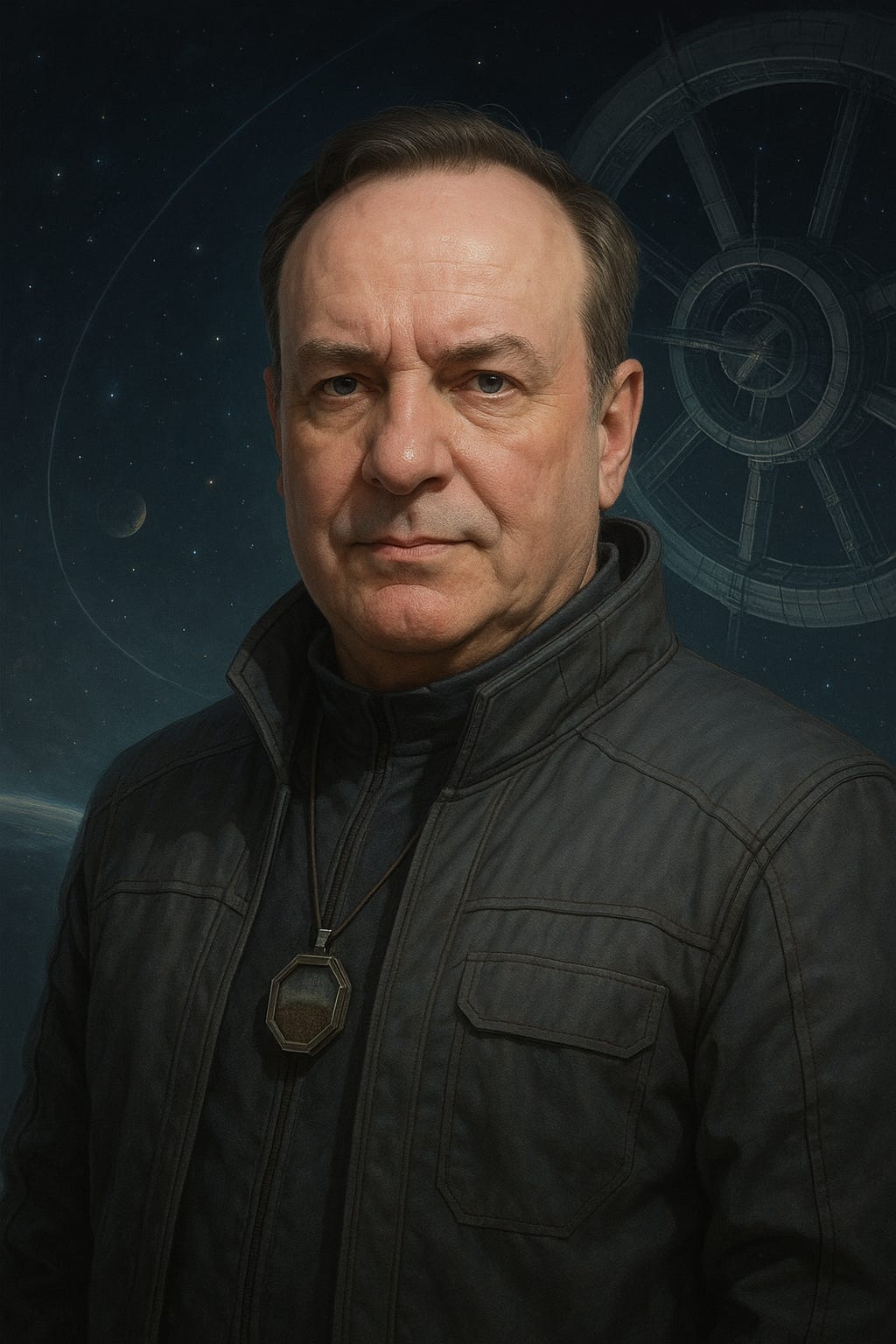
Looking at my doppelgangers again, I see reflections of me rather than random roles.
There’s some of me in each of them.
Like Matthias, I’m a maker — someone who learns by trying things out. Like Étienne, I have a streak of rebellion, a need to question how things are done. And like Orion, I can get lost in ideas, which is why I need collaborators to keep me anchored in the real.
Together they remind me that making, questioning, and connecting have always been the constants — whatever face I’m wearing next.
So I’ll bring all three of my doppelgangers with me to whatever comes next.
I’m ready for a new face. Are you?
Contact me. japhet@polarityreversal.com
Next Time: Why storytelling always loves a ‘C’ word…

 Polarity Reversal