When I proposed at the end of last week’s blog that I was going to post next about the c-word in storytelling, I was planning to write about the Latin word cum which, even if your memory of long-ago Latin classes is as addled as mine, you’ll know means “with,” as in the phrase summa cum laude — “highest with honour.”
Many of the words we associate with storytelling derive from cum as a root: words beginning in con- and com-. Content literally means “held together.” Context means “woven together.” Communicate means “shared together.” And so on. That’s because, as we all know, storytelling is about the relationship between teller and audience, between you and me. It’s how we bring things into connection.
But I wound up thinking instead about magic and its role in storytelling—specifically, what it means to create illusion honestly. That thought process was triggered by another c-word that has its origins in cum: Conjure. And that reminded me of the magic man in Harrods toy department when I was a child.
I used to watch him demonstrate tricks from the magic sets they sold. I was there so often, the magic man even let me assist him. This privileged role let me behind the curtain of the more elaborate parts of his short act—I quickly understood the sleight of hand, the optical illusions, the trap doors.
They were simple toy tricks — the disappearing ball and vase, the magic coin slide with the hidden compartment, a doctored deck of cards. Nothing complicated. A child could see through them.
But here’s what I learned: I could hold both truths at once. I knew how the tricks worked. And yet, when he performed, I still felt the wonder.
The magic wasn’t in hiding the gears. The magic was in the connection he made with his audience. The magic man had flair, he loved the stage, and he brought his audience into the magical circle. There was a pact—an unspoken agreement. Everyone knew what they were watching wasn’t “real” magic. They chose to be amazed anyway.
And that’s the real trick, isn’t it? The illusion isn’t deception; it’s collaboration. Which brings me to AI.
The tech industry wants to dazzle us. They want AI to feel magical—seamless, effortless, almost supernatural. “It just works,” as Steve Jobs famously said. And there’s nothing wrong with that impulse. Technology should delight.
But in their eagerness to create wonder, they’ve hidden the strings so well that we’ve started to forget who’s really performing the trick.
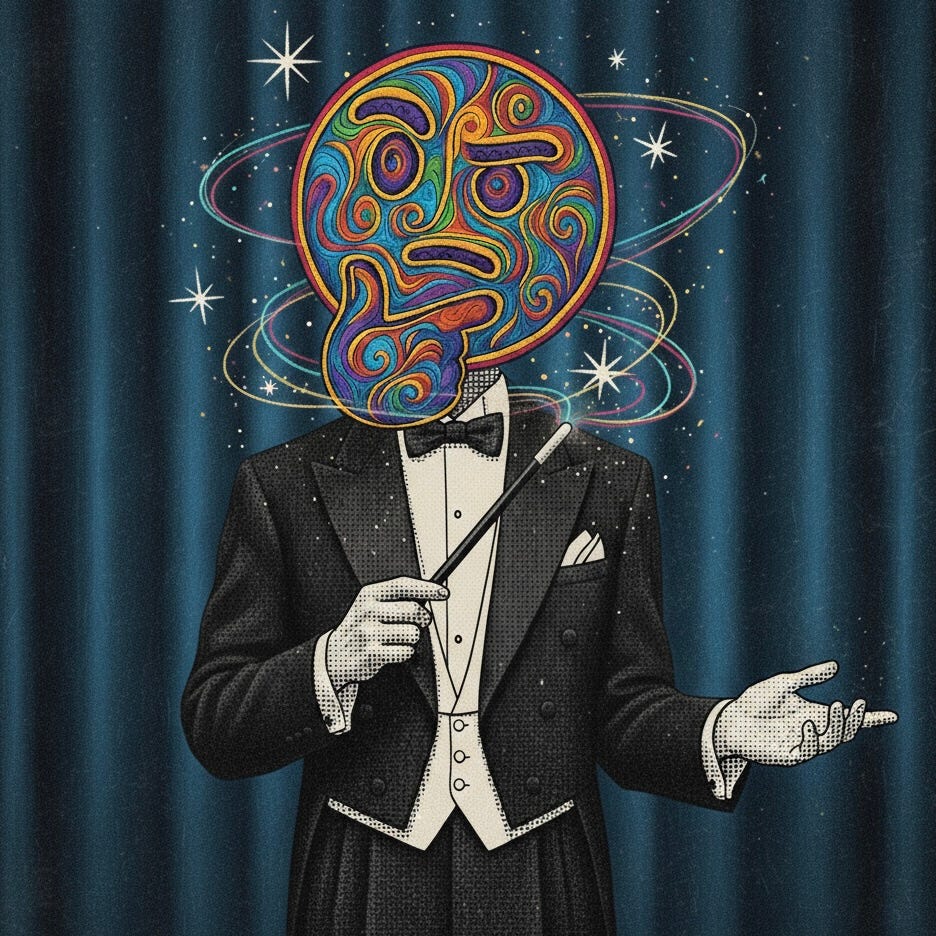
Perhaps we’ve become too easily dazzled. We’ve started believing the AI is the magician.
But conjure comes from Latin coniurare: con- (with/together) + iurare (to swear). It literally means “to swear together.” So conjuring at its origins was not about pulling something from nothing. It was about creating a binding through collective invocation — a pact between conjurer and audience.
The magic man couldn’t conjure wonder alone. He needed the audience to enter the agreement with him.
AI can’t conjure meaning alone either. It needs you.
We are the magicians, not the technology.
So when you work with AI, remember: your pact isn’t with the machine. It’s with your audience. The machine generates patterns. You conjure meaning. And meaning happens through all those other con- words we use in storytelling:
Confidence — Trust, but verify. Have confidence in your own judgment about what to keep, what to discard.
Community — Who are you making this for? What do they need to understand about how it was made?
Context — AI outputs have no context until you weave one around them.
Content — What are you actually holding together? And why does it matter?
These aren’t new concerns—they’re fundamental to all storytelling. But they become especially important when AI is part of your process. The tool is powerful. Your judgment about how to use it matters more than ever.
Be mindful of the con- words when you’re creating. They all point to the same thing: building your unique narrative bridge to your audience.
Assisting the magic man taught me that the tricks were simple, mechanical. But the performance—the connection, the shared understanding—that was real magic.
You’re not selling your soul to the devil when you use AI. You’re picking up a tool. A powerful one, sure, but still just a tool.
Explore what it can generate. Amplify what works. Discard what doesn’t. Turn its patterns into connections that matter to actual humans.
The magic isn’t in the machine.
The magic is in how you use it to connect with your audience and conjure wonder with them.
That’s the pact — not with the AI, but with your audience, your community, the people on the other side of what you make.
AI generates. You conjure. That’s where the magic lives.

 Polarity Reversal